
Deployment: Infectious SocioPatterns
Event description
The mission of the Science Gallery at the Trinity College in Dublin is to ignite creativity and discovery where science and art collide. It opened its doors in February 2008 and has since offered a changing programme of exhibitions, festivals and experiences. In 2009 the Science Gallery held four exhibitions, one of which was INFECTIOUS: Stay away. This exhibition investigated mechanisms of contagion and strategies of containment through science and art. It ran for three months.
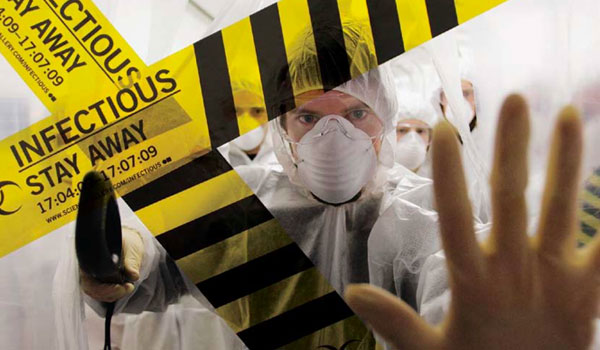
INFECTIOUS teaser movie.
Deployment description
Contributing to a better understanding of the spreading of infectious diseases has always been one of the research objectives of the SocioPatterns project. Given a human-to-human contact network, researchers can perform data-driven computer-based simulations of human-to-human infection spreading over that network. While the study of such infection dynamics considering the complex topology of cumulative contact networks is not new, the SocioPatterns project aims to contribute by enabling such studies on detailed datasets on physically grounded person-to-person contact that include the temporal dimension, allowing researchers to consider the causal order of contacts.
When the Science Gallery learned about the SocioPatterns project, they engaged us to consider a deployment in the INFECTIOUS exhibition. We gladly pursued this opportunity for a number of reasons. On one hand there was anticipated size of the dataset that could be collected during a deployment of that duration. But we were also very interested in the specific nature of the setting. The continuous flux of visitors forms a substrate for social interaction that is structurally different from those found in e.g. a school or a conference, but similar to those found in airports or train stations. Data on the person-to-person interactions in such a setting would thus form a scientifically relevant addition to our collection of datasets. As the organization of such a data collection operation is much more challenging because of the continuous flux of participants, the opportunity of partnering up with the Science Gallery to make it happen was consequently too good to not embrace.
Infectious SocioPatterns
To strengthen the engagement of the visitors, the behavior of the system was extended such that it became a continuous live simulation of the epidemic spreading of a contagious agent through person-to-person contact. Each badge worn by a visitor assumed one of two states: uninfected or infected. Upon entering the exhibition, the visitors’ badges were initially uninfected. The infected state, however, was contagious: uninfected badges could get infected when being near an infected badge. The current state of a badge was indicated by the blinking patterns of its LED light. Special badges were used to selectively seed the infection to some visitor, after which it was allowed to spread among the other visitors.
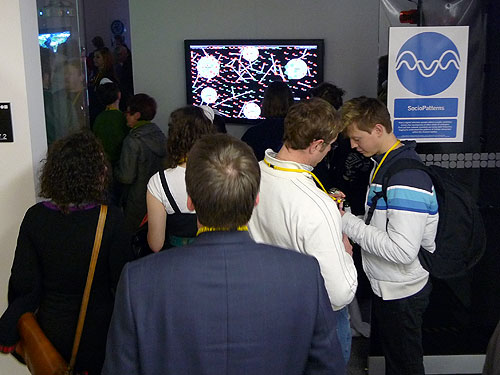
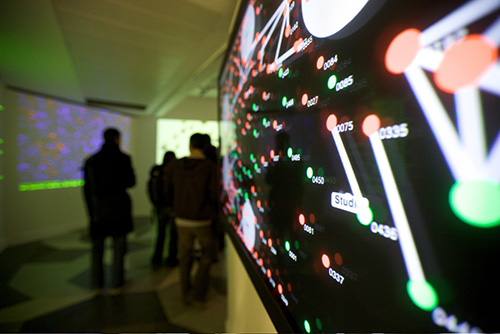
Real-time visualizations of the interaction network were located throughout the exhibition. In these visualizations the infected badges were shown as green marks, and infected as red marks. The system also involved a reactive part with audio-visual effects triggered by the proximity of infected badges.
The following is an extract from the April 16 journal on the national Irish TV (RTE) that should give you an idea of the exhibition in general and the dramatic framing of the tag distribution process, as well as some of the reactive features of the deployment.
Extract from the April 16 journal on the national Irish TV (RTE).
The following video offers a nice overview of the complete exhibition, starting with the Infectious SocioPatterns deployment.
Overview of INFECTIOUS exhibition
Pictures
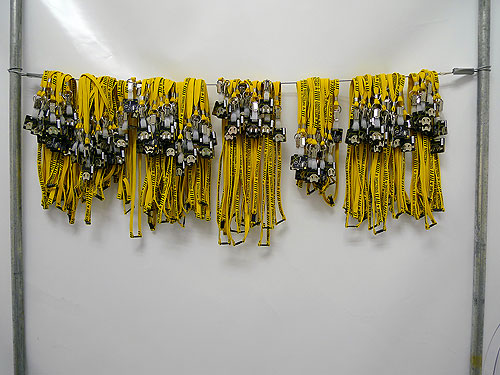
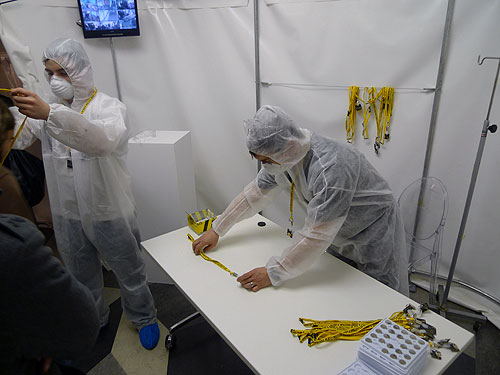
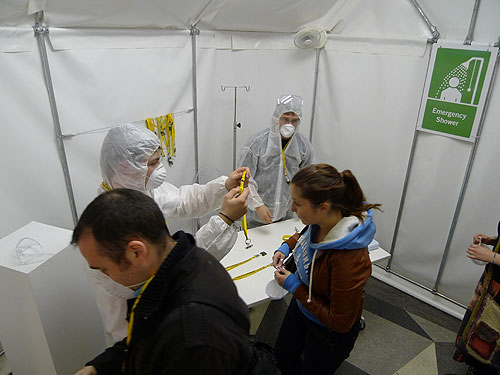
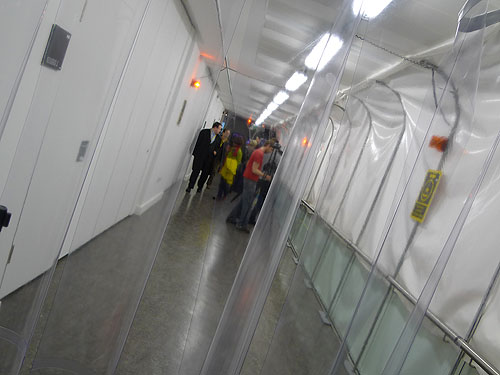
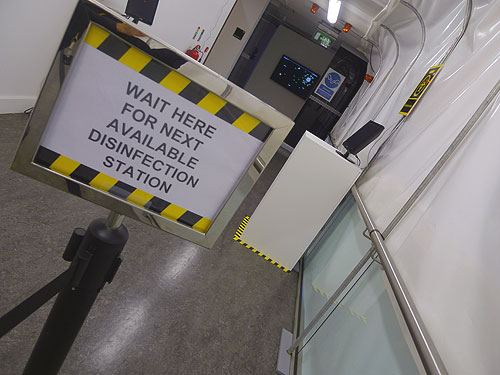
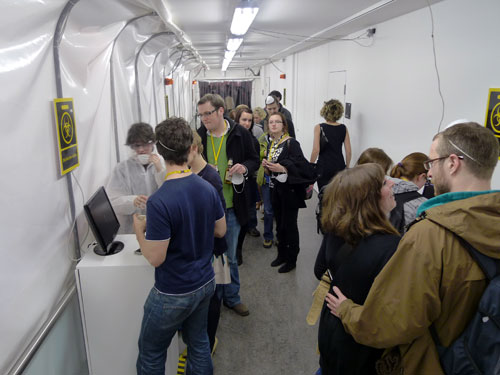
To wrap up this page, we would like to share some pictures from the exhibition.
Acknowledgements
- development: Ciro Cattuto and Wouter Van den Broeck
- deployment: Derek Williams, Don Pohlman, Ciro Cattuto, and Wouter Van den Broeck
- thanks to: the participants, Michael John Gorman, Vittoria Colizza, Alain Barrat, the exhibition hosts and hostesses, and the ISI administration
- sponsoring institutions:
- Science Gallery (Dublin, London)
- ISI Foundation (Torino, Italy)